* What kind of patient samples are used for the purpose of identifying possible pathogens?
* What does PCR do, how does it work, and why is it useful?
* How do you separate the desired DNA from all others?
* How does an automatic DNA sequencer work?
* Why is it possible to use a DNA sequence to identify bacteria?
1. Fluid from Lymph Node, Stool Sample, Urine Sample, Blood Sample, Sputum Sample, and Stool Sample from a Child.
2. PCR which is polymerase chain reaction is a scientific technique in molecular biologyto amplify a single or a few copies of a piece of DNA across several orders of magnitude, generating thousands to millions of copies of a particular DNA sequence. It's an inexpensive technique that can make segments of DNA. PCR can target specifics parts of DNA. This is useful for analyzing DNA especially for evidence taken at a crime scene.
3. A desired sequence is isolated by using restriction enzymes. They are enzymes that cut DNA at specific nucleotide sequences. PCR envolves a mixture of lots of stuff, but essentially, you are using a cell called a competent cell to preform a transformation. The cut DNA is introduced into the cell which acts like a machine to copy that DNA over and over again. PCR means Polymerase Chain reaction. Polymerase is the enzyme reponsible for DNA replication.
4. Automated deoxyribonucleic acid (DNA) sequencing reduces the volume of low-level radioactive waste generated on campus, while providing a suitable alternative to manual DNA sequencing. Traditional methods of manual DNA sequencing utilize radioactive isotopes to label the DNA. Automated DNA sequencing utilizes fluorescent tracers instead of radioisotopes to label the DNA, thereby eliminating or significantly reducing the use of radioactive materials in some research laboratories.
5. It is possible because each strain of bacteria have their own specialized DNA sequence.
Monday, November 14, 2011

Sunday, November 6, 2011
The cell's highest rate of diffusion
What shape (radius, villi and dimples) and size allow a cell to have the highest rate of diffusion?
Radius: 1x
Villi: 20% of cell surface area.
Dimples: 80, 1% of cell surface area.
Cell Shape: 10:1.

Radius: 1x
Villi: 20% of cell surface area.
Dimples: 80, 1% of cell surface area.
Cell Shape: 10:1.

vaccination
All vaccinations work by presenting a foreign antigen to the immune system in order to evoke an immune response, but there are several ways to do this. The four main types that are currently in clinical use are as follows:
- An inactivated vaccine consists of virus or bacteria which are grown in culture and then killed using a method such as heat or formaldehyde. Although the virus or bacteria particles are destroyed and cannot replicate, the virus capsid proteins or bacterial wall are intact enough to be recognized and remembered by the immune system and evoke a response. When manufactured correctly, the vaccine is not infectious, but improper inactivation can result in intact and infectious particles. Since the properly produced vaccine does not reproduce, booster shots are required periodically to reinforce the immune response.
- In an attenuated vaccine, live virus or bacteria with very low virulence are administered. They will replicate, but locally or very slowly. Since they do reproduce and continue to present antigen to the immune system beyond the initial vaccination, boosters may be required less often. These vaccines may be produced by passaging, for example, adapting a virus into different host cell cultures, such as in animals, or at suboptimal temperatures, allowing selection of less virulent strains, or by mutagenesis or targeted deletions in genes required for virulence. There is a small risk of reversion to virulence, this risk is smaller in vaccines with deletions. Attenuated vaccines also cannot be used by immunocompromised individuals. Reversions of virulence were described for a few attenuated viruses of chickens (infectious bursal disease virus, avian infectious bronchitis virus, avian infectious laryngotracheitis virus [4], avian metapneumovirus [5])[14]
- Virus-like particle vaccines consist of viral protein(s) derived from the structural proteins of a virus. These proteins can self-assemble into particles that resemble the virus from which they were derived but lack viral nucleic acid, meaning that they are not infectious. Because of their highly repetitive, multivalent structure, virus-like particles are typically more immunogenic than subunit vaccines (described below). The human papillomavirus and Hepatitis B virus vaccines are two virus-like particle-based vaccines currently in clinical use.
- A subunit vaccine presents an antigen to the immune system without introducing viral particles, whole or otherwise. One method of production involves isolation of a specific protein from a virus or bacterium (such as a bacterial toxin) and administering this by itself. A weakness of this technique is that isolated proteins may have a different three-dimensional structure than the protein in its normal context, and will induce antibodies that may not recognize the infectious organism. In addition, subunit vaccines often elicit weaker antibody responses than the other classes of vaccines.
Thursday, October 27, 2011
cell movements
Diffusion: Examples are respiration and excretion in animal bodies. Oxygen is passed from lungs to cells by a process of diffusion. The carbon dioxide excreted by the cells is diffused to the lungs. Diffusion is also central to the process of excretion. When there is excess water it is diffused to the kidneys, and when there is less water it is diffused back to the body. (http://www.enotes.com/science/q-and-a/describe-two-2-examples-diffusion-occurs-living-197053)
Facilitated Diffusion: facilitated diffusion is a type of passive transport, it moves substances down their concentration gradient without using the cell's energy Active Transport. EX. Glucose is the body's primary source of direct energy. Our cells have a membrane protein that facilitates the diffusion of glucose from the bloodstream into the cell. (http://en.wikipedia.org/wiki/Facilitated_diffusion)
Osmosis: osmosis is the movement of solute from a higher concentration to lower concentration. EX. Plant absorb water from the earth through the process of osmosis. Exchange of water in body fluids and body cells in animals (including humans) takes place through osmosis. (http://en.wikipedia.org/wiki/Osmosis)
Phagocytosis: EX. your white blood cells attacking foreign bodies. (http://en.wikipedia.org/wiki/Phagocytosis)
Active transport: Active transport is the movement of a substance against its concentration energy. It need senergy to move. An example could be the uptake of glucose in the intestines.(http://en.wikipedia.org/wiki/Active_transport)
Facilitated Diffusion: facilitated diffusion is a type of passive transport, it moves substances down their concentration gradient without using the cell's energy Active Transport. EX. Glucose is the body's primary source of direct energy. Our cells have a membrane protein that facilitates the diffusion of glucose from the bloodstream into the cell. (http://en.wikipedia.org/wiki/Facilitated_diffusion)
Osmosis: osmosis is the movement of solute from a higher concentration to lower concentration. EX. Plant absorb water from the earth through the process of osmosis. Exchange of water in body fluids and body cells in animals (including humans) takes place through osmosis. (http://en.wikipedia.org/wiki/Osmosis)
Phagocytosis: EX. your white blood cells attacking foreign bodies. (http://en.wikipedia.org/wiki/Phagocytosis)
Active transport: Active transport is the movement of a substance against its concentration energy. It need senergy to move. An example could be the uptake of glucose in the intestines.(http://en.wikipedia.org/wiki/Active_transport)
Wednesday, October 26, 2011
Three Types of Cells
Single Cell : Plant Cell : Animal Cell :


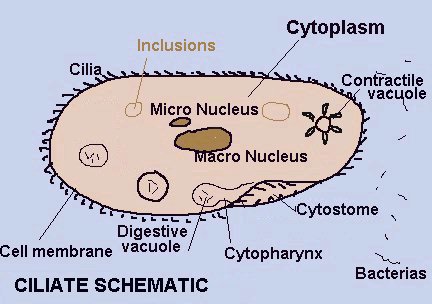
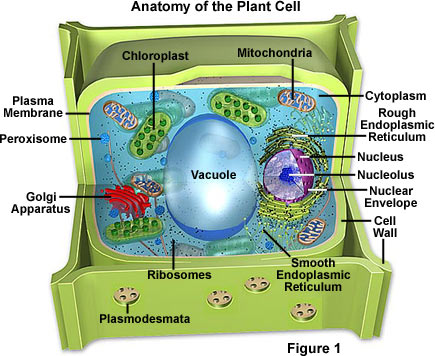

Animal and plant cells are eukaryotes, which means they all have a nucleus. However, some single cell doesn't contain a nucleus, while others contain more than one nucleus. Also, plant cell has a cell wall, which both animal and single cells don't have.
Saturday, October 8, 2011
Five Types of Nutrients
1) Carbonhydrates


Carbohydrates are the main source of energy. It provides glucose for the body.
2) Fats

Fats are an important part of a healthy diet. It contains essential fatty acids, which helps the body to produce cell membranes, myelin sheaths, and certain hormones.
3) Proteins

Proteins supply raw materials for growth and repair of structures such as skin and muscle. It also have regulatory and transport functions.
4) Vitamins

Vitamins are organic molecules that help regulate body processes, often working with enzymes.
5) Minerals

Our body needs small amounts of minerals such as calcium, iron, and magnesium. It is a major component of bones, teeth, and hemoglobin. It also required for normal functioning of nerves.


Subscribe to:
Posts (Atom)